

Measurement
Influencer agencies measurement: populations and an evidence ladder
Influencer agencies measurement: keep separate populations, build an evidence ladder and compare agency proposals on the evidence behind their figures.
Influencer agencies measurement should tell an England advertiser what happened, to whom, under which definition, and what decision follows. It should not compress creator recruitment, content delivery, platform observations and sales into one flattering percentage. A defensible report preserves the route from raw event to conclusion and marks the point where observation becomes attribution or a causal claim.
This guide was researched for creatorcampaign.co.uk on 6 September 2026. UK regulator and government sources govern the cited evidence boundaries. Google, TikTok and YouTube pages describe their own global products and cannot validate an England campaign. No direct authoritative England benchmark for influencer-agency performance was found in the sources reviewed.
What to take away
- Write one decision before choosing a metric, and name the advertiser owner and decision date.
- Keep separate populations for each stage, from eligible creators to incremental outcomes, so numerators and denominators match.
- Give every measure a card that records its decision, population, period, provenance and boundaries.
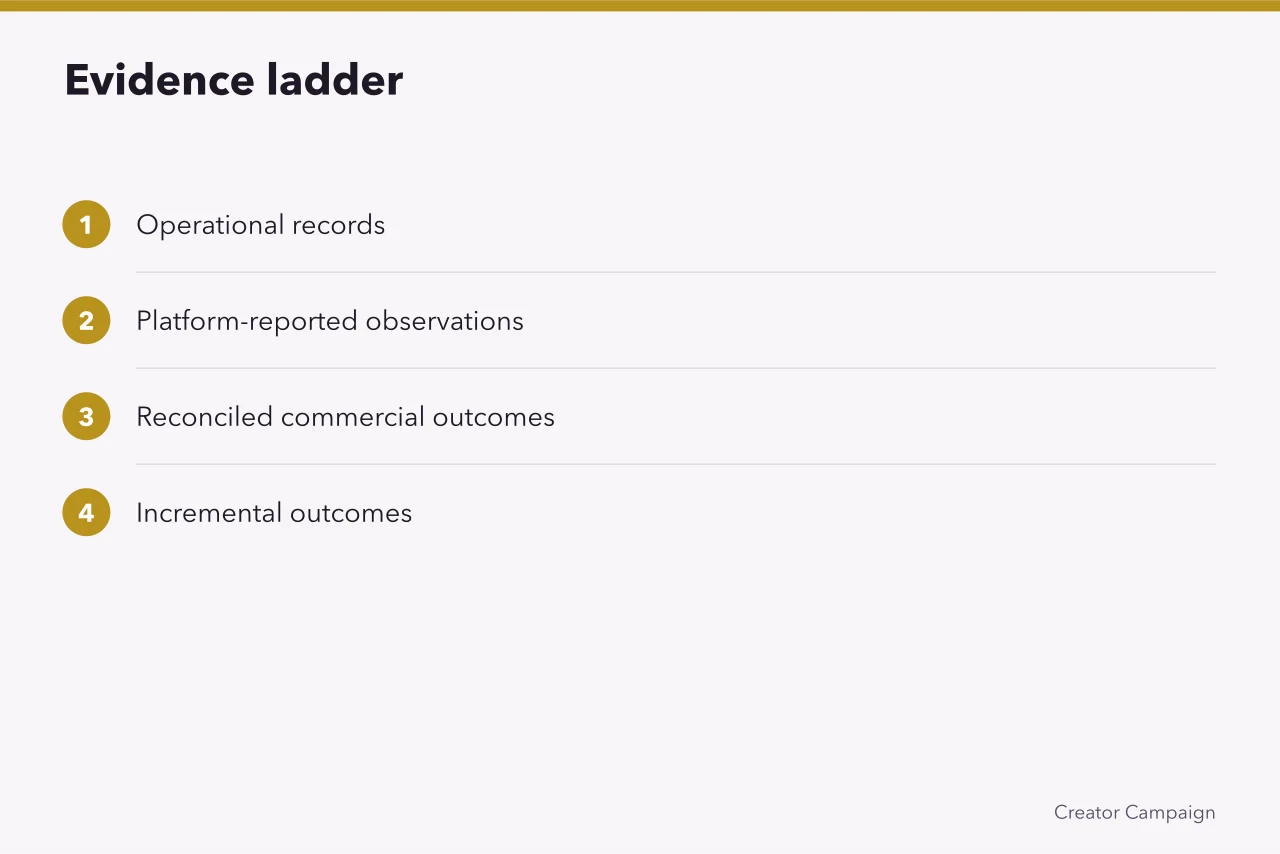
- Build an evidence ladder from operational records to platform observations, reconciled outcomes, attributed outcomes and causal impact.
- A causal claim requires a counterfactual design; otherwise report delivery and attributed activity without calling either incremental.
Start with the decision, not the dashboard
Write one decision before choosing a metric. It might be whether to continue a creator-search route, accept a group of assets, renew an agency workstream or commission a stronger impact evaluation. Name the advertiser owner and the date on which that person must decide.
Next, state the objective without substituting a platform label. "Assess whether approved creator assets were published as contracted" is an operational objective. "Increase conversions" is incomplete until the conversion event, eligible buyers, period, exclusions, source and comparison are fixed. A platform conversion is credit assigned under a reporting rule, not automatically an incremental sale.
The Cabinet Office and HM Treasury QPIE guidance distinguishes monitoring a change from determining whether an intervention caused it. Its UK public-policy context is not an influencer-campaign recipe, but the counterfactual principle is directly useful when an advertiser makes a causal claim.
Keep the populations apart
A clean measurement register gives every stage its own population. At minimum, preserve:
- creators who met the documented eligibility rules;
- eligible creators contacted through an authorised route;
- contacted creators who gave a qualifying response;
- creators with executed contracts for the measured scope;
- contracted creators whose assets reached the approval state;
- approved assets scheduled for release;
- assets verified as published in the agreed format and period;
- platform-reported views, impressions or interactions under a recorded definition;
- commercial events matched under a declared attribution rule;
- reconciled value and the complete economic cost; and
- incremental outcomes estimated by a suitable causal design.
Do not use the eligible-creator count as the denominator for an asset-approval measure, or divide attributed orders by estimated viewers and call the result a conversion rate. The numerator and denominator must describe the same unit and eligibility rule.
Give every measure a card
A measure is not ready merely because the software exports it. Its card should contain these fields:
- the decision the measure informs, the advertiser owner and the decision date;
- the population, its eligibility rule and the unit counted;
- the numerator and denominator, written in words as well as in symbols;
- the period, time zone and data cut-off;
- the source system, field names, extraction time and version;
- the evidence statusobserved, estimated, modelled, attributed, forecast or causal;
- the value boundary, including the full economic cost where value is claimed;
- the known limitations, missing records and uncertainty; and
- the action threshold and the named reviewer who may approve it.
Measure card fields
- Decision and eventquestion and exact record trigger
- Eligible populationwho or what enters the denominator
- Numerator and denominatorcounted subset and full base
- Period and clockstart, end, timezone, attribution window
- Provenancesource system, account, export or query, version
- Boundariesinclusions, exclusions, deduplication, identity
- Data qualitymissing, late, modelled, suppressed, corrected
- Accountability and decision ruleowner, reviewer, blank threshold
Record the formula in words as well as symbols. "Qualifying response rate = creators with a qualifying response / eligible creators contacted" is interpretable only after "qualifying", "contacted" and the observation period are defined. Leave the action threshold blank until the buyer approves it from risk appetite and baseline evidence.
Worked example. Suppose the decision is whether to renew a creator-search route. The card records the decision, the advertiser owner and the review date; the population of eligible creators contacted through the authorised route; the numerator as contacted creators giving a qualifying response under the written definition; the denominator as eligible creators contacted; the period and cut-off; the evidence status as observed from the campaign record; the limitation that part of the response record was keyed by hand; and the action threshold, left blank until the buyer approves it.
ONS describes statistical quality as fitness for purpose across relevance, accuracy, timeliness, clarity and coherence and comparability. Although agency reports are not official statistics, those dimensions are a sound challenge list. A timely number with an unstable definition is not comparable.
Build an evidence ladder
The ladder runs in a fixed order. Each rung answers a different question and carries its own claim boundary:
- Operational recordswhat the buyer can evidence about eligibility, contact, contract, approval and publication.
- Platform-reported observationswhat the platform states under its own definitions, extraction time and period.
- Reconciled commercial outcomeswhat internal systems accept after cancellations, returns and a fixed cut-off.
- Attributed outcomeswhich credit rule assigns events to the campaign, without recreating the world without it.
- Causal impactwhat a counterfactual design supports, or an explicit statement that none is feasible.
Operational records
Start with events the buyer can evidence: eligibility decision, contact attempt, response category, signed contract, approved asset version, scheduled slot, live URL capture, correction and withdrawal. The source is the controlled campaign record, not a retrospective slide. Record late updates and preserve the earlier version.
Platform-reported observations
Keep the platform name, metric label and definition link beside every figure. Add the account, extraction time and reporting period.
YouTube defines unique viewers as an estimated number within a selected period, distinct from views, in its first-party audience documentation. That definition is global product information, and it proves nothing about unique people in England, another platform's field or advertising effect.
Mark whether a figure is observed, estimated or modelled. Google explains that its conversion modelling predicts unobserved conversions in some circumstances. A buyer may use the field, but the report should not relabel it as a directly observed transaction.
Reconciled commercial outcomes
Create an internal event definition: an accepted order after cancellations and returns through a fixed cut-off. Reconcile event IDs where permitted, document unmatched records, state which system governs value.
Separate gross revenue, contribution and full economic cost. Keep creator consideration, gifts, agency fees, paid media and production in the cost boundary. Must also include software, internal labour, assurance, remediation and tax treatment.
Attributed outcomes
Attribution assigns credit according to a rule. It does not recreate the world without the campaign. Google says an attribution model determines how credit is allocated across eligible ad interactions in Google Ads. Its separate conversion-window page shows that the chosen period controls which post-interaction events are recorded.
TikTok's global help page, updated in November 2025, documents selectable click-through and view-through windows in its ad-group attribution settings. These records illustrate why two platform totals should not be added: eligibility, window, view treatment and model can differ, and the same commercial event may receive credit twice.
Causal impact
A causal estimate asks what would have happened without the influencer work. Predefine the outcome and counterfactual before release where feasible. Randomised holdouts or a credible quasi-experimental comparison can support stronger inference, provided assignment, contamination, sample size and data quality are reviewed. A before-and-after chart without a suitable comparison remains descriptive.
If a causal design is not proportionate or feasible, say so. Report operational delivery and attributed activity without calling either incremental impact. A contribution narrative can organise evidence and rival explanations, but should not be expressed as a causal percentage unless its method warrants that claim.
Make the dashboard a data contract
The dashboard specification should precede its visual design. For every tile, identify the event table, field names, permitted values, join rule, deduplication key, query version, refresh schedule, data cut-off and accountable owner. Store the numerator and denominator, not only the resulting ratio.
Give late data an explicit policy. A period might be provisional until a buyer-set close date, then revised if an approved correction arrives. The visible report should show freshness, completeness and version. Never silently overwrite a previously circulated figure.
Use one status for absent records and another for genuine zero. "Unknown", "not yet received", "suppressed" and "not applicable" are not interchangeable. A missing creator export cannot become zero engagement. Record any estimation method and uncertainty separately from observed values.
Restrict row-level access. Campaign reporting can contain creator contact information, audience data or customer events. The ICO's final 2026 storage and access technologies guidance announcement confirms that PECR and, where relevant, UK GDPR apply to technologies including tracking pixels and device fingerprinting. A named privacy and PECR reviewer must assess the actual implementation. A dashboard does not make collection permissible.
Treat recognition and performance as different questions
Advertising recognition is an outcome worth testing, but it is not reach, engagement or sales. ASA research published in February 2026 examined how consumers recognised influencer advertising, primarily across Instagram and TikTok, and reports that presentation and disclosure affected recognition. Read the full research page for its method and population before reusing a finding.
For a live campaign, define the approved disclosure version and inspect the rendered post at publication. The evidence can include a timestamped capture and, if commissioned, a permissioned recognition study. Do not infer audience understanding from the presence of a platform label alone. Keep claims substantiation, advertising recognition, accessibility and campaign performance as separate acceptance gates.
Resist borrowed benchmarks
Current authoritative sources reviewed give no comparable England benchmark for influencer-agency response, engagement, conversion or return; ASA's recognition study is UK consumer research, not an agency league table.
Supplier case studies, platform averages and cross-market surveys may be useful leads. Their creator mix, audience, format and paid amplification must match before comparison; so must denominator and data access. "No usable benchmark" is a valid research result.
Use an internal baseline only after freezing its definition. Compare like with like across equivalent periods and keep changes to platforms, campaign purpose, creator eligibility or measurement method visible. ONS guidance on survey uncertainty explains why sample estimates can differ from unknown population values and why uncertainty matters. It does not supply a threshold for this niche.
Run a publication and decision review
Before a report leaves the working group, ask the statistician or evaluation reviewer to check definitions, denominators, uncertainty and causal language. Privacy and PECR reviewer checks data collection, matching, access, retention and suppression.
Advertising and consumer reviewers examine how performance and disclosure findings are described. Finance checks value and full-cost boundaries. Accessibility review covers the delivered report, not just its template.
The final decision note should state:
- which evidence is observed, platform-reported, modelled, attributed, forecast or causal;
- which period and geography it represents;
- which records are missing, late, duplicated, suppressed or revised;
- what the evidence cannot show;
- the buyer-owned threshold and action, left blank until approved;
- who can pause, correct, withdraw or commission more research; and
- when definitions and source documentation must be rechecked.
The operational default is HOLD when the denominator cannot be reconstructed, a platform definition is missing, attributed events cannot be reconciled, privacy permission is unresolved or causal wording outruns the design. Measurement earns confidence through traceability and restraint, not through the number of tiles on a screen.
Editorial and qualified review note
This is a desk-researched framework, not professional statistical, legal, privacy, advertising, accounting or accessibility advice. A named UK statistician or evaluation specialist, privacy and PECR adviser, advertising and consumer reviewer, finance reviewer and accessibility specialist must assess the configured campaign, data and report before publication. Recheck official and first-party definitions on the release date.
Before you act
- Write one decision and name the advertiser owner and date.
- Define each population separately and match numerator to denominator.
- Complete a measure card before using any metric.
- Ask each shortlisted agency for the same measurement artefacts.
- Label figures as observed, estimated or modelled.
- State attribution rules and avoid adding platform totals.
- Say whether a causal design is feasible or not.
Common questions
Why should an advertiser avoid compressing creator recruitment, content delivery, platform observations and sales into one percentage?
A single flattering percentage hides the route from raw event to conclusion. The article says a defensible report preserves that route and marks where observation becomes attribution or a causal claim. Compressing stages also mixes different populations, making numerators and denominators inconsistent.
What is the difference between an attributed outcome and a causal impact estimate?
Attribution assigns credit according to a rule, such as a platform conversion window, but does not recreate the world without the campaign. A causal estimate asks what would have happened without the influencer work, using a counterfactual design such as randomised holdouts or a credible quasi-experimental comparison.
How should a dashboard handle late data and missing records?
Give late data an explicit policy: a period may be provisional until a buyer-set close date, then revised if an approved correction arrives. Show freshness, completeness and version, and never silently overwrite a circulated figure. Use separate statuses for unknown, not yet received, suppressed and not applicable.
In this guide
- A small set of influencer-agency metrics with fixed events, denominators and a release conditionChoose a small set of England influencer-agency metrics with fixed events, denominators, evidence, uncertainty and buyer-owned campaign decisions.
- Influencer agencies reporting dashboard: buyer checklistUse this influencer agencies reporting dashboard checklist to assess an agency's data definitions, refresh rules, corrections, privacy and decision evidence.
- Influencer attribution methods: how to compare them on one campaignCompare influencer attribution methods on one campaign: evidence grids, platform claims, counterfactual tests, descriptive review, and no universal winner.
- Influencer agency measurement mistakes to check in reportsInfluencer agencies measurement mistakes: spot blended populations, missing data, platform credit and unsupported causal claims in campaign reports.
- How to vet an influencer-agency benchmark figure in EnglandHow to vet influencer agencies benchmark research in England: what ASA, platform and ONS sources cannot support, nine fields to request, a release rule.